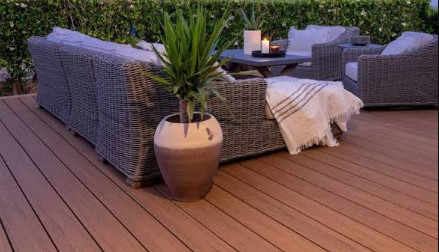
Composite decking costs more to install and less to own. That is the short answer for a Kansas City homeowner holding two bids on the same backyard, and the rest is arithmetic. Wood wins the first invoice. Composite wins most of the years after it. Before either bid gets signed, look at completed deck installation Kansas City MO work in both materials, because a rack sample tells you nothing about how a deck ages here. The ten year number should decide this, not the front page of the estimate.
Upfront Price Tells Only Half The Story
Decking prices behave a lot like printer prices. The cheap machine on the shelf is subsidized by cartridges you keep buying for five years. The expensive one takes its money at the register, then leaves you alone. Boards are no different. Pressure-treated lumber is the cheap printer here, cedar sits in the middle, and composite asks for almost all of its money on the day the crew leaves.
Here is the argument in one line. It is not the one either salesperson leads with. Over ten years, the material you pick matters far less to your wallet than the two bids suggest. The real tiebreaker is how long you intend to own the house. A homeowner planning to sell in four years should probably buy the cheap boards. Someone whose toddler will graduate off that same deck in eighteen years is solving a different problem.
See also: Life Insurance: The Conversation Too Many People Put Off
Where Wood Decks Cost You Every Season
Wood does not fail all at once. It fails on a schedule, and the schedule starts the first spring after the install. A cedar or pressure-treated deck in the metro wants a cleaning and fresh stain about every other year. South facing sections that take full sun from noon to dinner come due sooner. Skip two cycles and the boards go gray, cup, and splinter at the ends. What we see most often on a ten year old wood deck is not a collapsed structure but a tired surface. Fasteners back out, boards go soft, and the railing flexes. (Nobody has ever enjoyed a stain weekend, and if you have, keep it to yourself.) The boards start giving up somewhere around year eight.
Older decks carry a wrinkle that has nothing to do with looks. Structures built before 2003 were commonly pressure treated with arsenic based CCA, and Dartmouth College’s Arsenic and You project recommends sealing that wood at least once a year. If you are tearing out a deck of that vintage, the history matters before anyone starts sanding.
The part nobody prices is the framing you cannot see. In June 2026 a back deck in Long Valley, New Jersey pulled away from the house during a party with eleven people on it. The local Patch site reported seven hurt, six of them hospitalized, and a gas leak in the wreckage. Ledger connections rot quietly behind a trim board, whatever the decking on top is made of. If a deck ever drops while people are on it and you smell gas, get everyone away from the building and call 911 from the street before anyone goes back inside.
Running The Ten Year Number On 320 Square Feet
Run it on a 320 square foot deck. At an example rate of $30 per square foot installed, the pressure-treated build comes to $9,600 on day one. Restaining runs about $2.50 per square foot, so each round is another $800. Do that in years two, four, six, eight and ten and upkeep adds $4,000, which puts the decade at $13,600 all in. Price the same footprint in composite at an illustrative $42 per square foot and you are out $13,440 before the first cookout. Add maybe $40 a year in cleaner and a stiff brush, and it comes to roughly $13,840 by year ten. Two very different first invoices. A few hundred dollars apart once the decade is done.
Two things move that comparison more than the boards do. Labor is the first: hire out the staining and wood’s upkeep column roughly doubles. That pushes composite ahead well before year ten. Footings and framing are the second, and they cost about the same either way.
Spending Smart On A Deck That Lasts
Buy for the load and the years, not the brochure. The code frames a residential deck for a 40 pounds per square foot live load, while the American Wood Council explains that a deck seating paying customers is an assembly use rated at 100 psf under ASCE 7. Your backyard is not a restaurant patio, but the gap is a reminder that a graduation party loads those joists hard. Ask any builder bidding deck installation Kansas City MO work to price the maintenance beside the build.
The honest version is that neither material is a mistake. Pressure-treated boards on solid framing, restained on time, will serve a family for a decade and cost the least to install. Composite takes more money up front, hands back every stain weekend, and holds color longer than wood will. Pick the one that matches how long you are staying and how much of a Saturday you are willing to spend. Then put the difference into the part you cannot see, the framing holding all of it up.